
By Chang Min Park
Accredited Specialist in Immigration Law
Legal Practitioner Director of Park & Co Lawyers
A headline saying “the student visa rules have changed” leaves several questions unanswered. What changed? When does it take effect? Does it affect an application already lodged?
As an Accredited Specialist in Immigration Law, I recommend working back from the announcement to the actual legal document. The wording, commencement provisions and application rules are what determine the effect of a change.
The Australian Migration Law Changes — in Plain English tracker helps you find those documents. Hosted on GitHub Pages, it brings together public legislation records in a monthly timeline, with links to the official legislation and explanatory material.
You can open it like any other website. No GitHub account or technical knowledge is required. If the page opens in Korean, select English near the top.
The tracker collects and summarises material automatically. This guide explains how to use it to locate a change and then check the source.
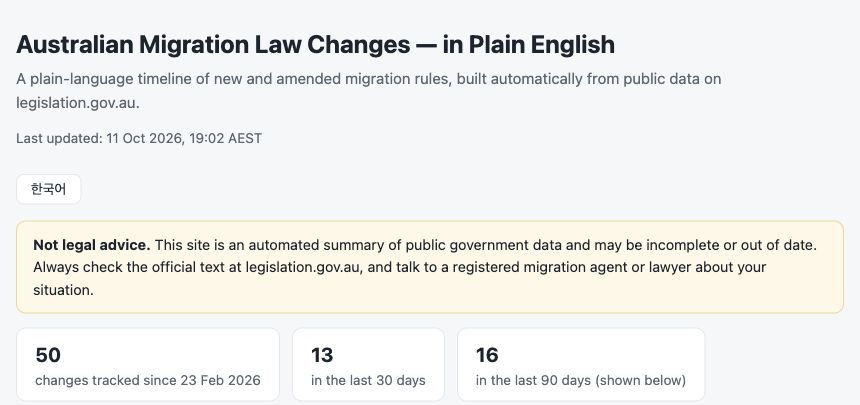
1. Check when the page was updated
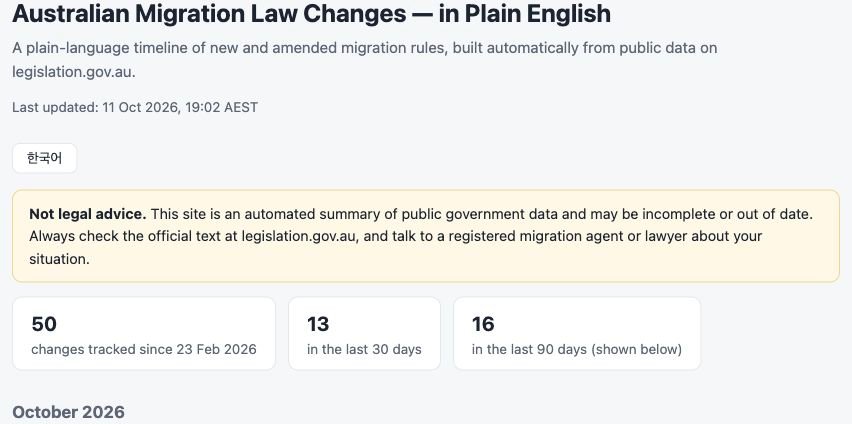
Start with Last updated near the top of the page. The figures below it show the number of entries tracked since the site began, in the last 30 days and in the last 90 days.
An entry may replace an earlier instrument, deal with an administrative matter or make a narrow amendment. It does not necessarily mean that visa eligibility has changed. Read the entry before drawing a conclusion from its title.
2. Find the visa or subject you are interested in
The most recent entries appear first, grouped by month. Use Ctrl+F on Windows or Command+F on a Mac to search the page. On a phone, use your browser’s “Find in page” option.
Try a visa name, subclass number or subject: Student or 500, Temporary Graduate or 485, Application Charge, or Health Criteria.
Read the full title and the document extract. The “Who is affected” labels are generated automatically; a matching label does not establish that the change applies to your application.
3. Separate registration from commencement
Each card displays Registered, Starts and an FRLI ID. Registration records when the document was registered on the Federal Register of Legislation. Commencement concerns when the relevant provisions take legal effect.
Those dates are not interchangeable. The tracker’s “Starts” field is a useful prompt to look further, but do not assume that an automatically extracted date is correct. Open the official instrument and read its Commencement provision. Different parts of an instrument may start on different dates, as the Register’s guide to reading legislation explains.
Keep the FRLI ID, such as a reference beginning F2026L. It identifies the document and makes it easier to find again or share with your adviser.
4. Read the official text and its explanatory statement together
Select Official text on legislation.gov.au to open the instrument on the Federal Register of Legislation. Where available, the card also links to an Explanatory Statement (PDF).
An explanatory statement describes the purpose and operation of the instrument. It can be a useful place to start before reading the operative wording. The Register provides guidance on explanatory statements.
Check which version you are reading. The as made version shows the instrument in its original form. For a question about the law now, check for later amendments and the current compilation where applicable. For an earlier application or decision, identify the version relevant to that date. The Register’s frequently asked questions explain its version and history features.
5. Check which applications the amendment covers
Knowing the commencement date is only part of the task. Check any application, saving or transitional provisions as well.
Does the amendment apply to applications lodged from a particular date, to decisions made from that date, or to applications already on foot? Are there exceptions or arrangements for existing applicants? A short summary saying “the rules changed” cannot answer those questions.
If you need advice, bring the instrument link, your visa subclass and your application date. Those details help your adviser work out which provisions need to be checked.
6. Use the archive to revisit an earlier change
Scroll to the older archive and expand the month you need before searching its entries. A browser’s page search may not find text inside a collapsed section.
The glossary below the archive explains terms such as commencement, explanatory statement and subclass. When revisiting an older amendment, check whether it has since been amended or replaced.
For a student visa update, for example, start by finding Student or 500, identify the relevant instrument, and open both the official text and explanatory statement. Then check commencement, application provisions and the relevant version of the law.
That gives you a clearer basis for understanding the change than a headline or a social media summary alone.
Open the Australian Migration Law Changes tracker
If you would like advice on how a migration law change affects your circumstances, contact Park & Co Lawyers. You can also send an enquiry using our online enquiry form.
This article provides general information. The tracker’s automated summaries may be incomplete or out of date; individual advice requires an assessment of your circumstances and the applicable law.
Does a new rule automatically apply to an existing application?
Not necessarily. Check the instrument’s commencement and application or transitional provisions, along with the version relevant to your application or decision. The tracker’s summary is a starting point for that check.
Can I rely on the tracker without opening the source?
Use it to find a change, then open the original legislation and explanatory statement. Automated summaries can miss qualifications, exceptions or later amendments.
Australian immigration with an Accredited Specialist
For advice on your circumstances, see Park & Co Lawyers’ enquiry details. If your question is about the wait for a visa decision, read our Australian visa processing time guide.